


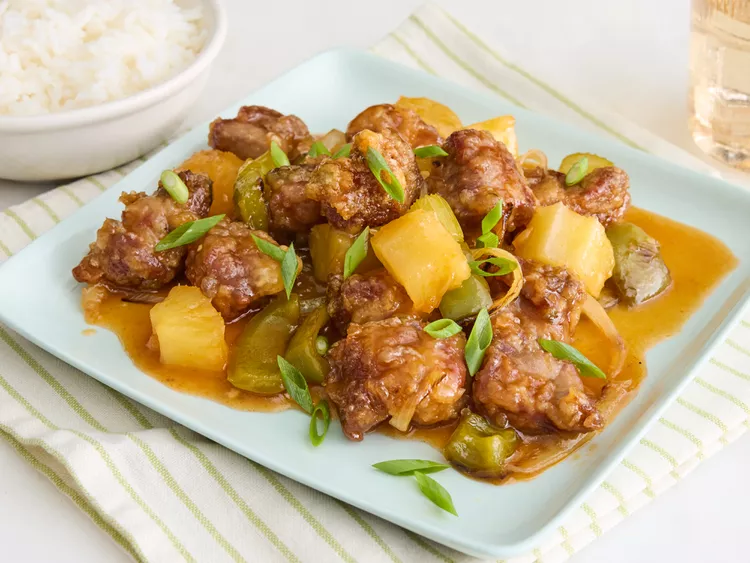
Culinary Masterclass: The Definitive Guide to Sweet and Sour Pork III
Abstract
Sweet and Sour Pork (gu lo yuk) stands as a pillar of Cantonese gastronomy and its Western adaptation. While often dismissed as mere comfort food, the dish, when executed with technical precision, is a complex study in textural contrast and flavor balance. The “III” designation in this recipe indicates a tertiary stage of refinement—a formula that has evolved beyond basic home-cooking methods to incorporate restaurant-grade techniques such as double-frying and starch-based velveting. This article serves as a definitive guide to constructing the perfect Sweet and Sour Pork, prioritizing a shatteringly crisp crust, succulent meat, and a sauce that achieves the ideal pH balance between acidity and sweetness.
Introduction: The Architecture of the Dish
The enduring popularity of Sweet and Sour Pork lies in its ability to stimulate the palate through opposing forces. It is a dish defined by duality: the savory, fatty richness of the pork against the sharp brightness of the vinegar; the crunch of the fried batter against the viscosity of the glaze.
However, achieving this equilibrium is difficult. Inferior iterations suffer from common technical faults: sogginess due to low oil temperature, toughness due to improper meat selection, or a sauce that is cloyingly sweet rather than complex. This protocol—Sweet and Sour Pork III—corrects these variables. It utilizes a high-amylose batter strategy (increasing cornstarch ratios) and a precise sauce reduction technique to ensure the coating remains crisp even after being dressed.
Ingredient Methodology
To replicate professional results, the selection of raw materials must be rigorous.
The Protein
-
The Cut: The optimal cut for this preparation is Pork Shoulder (Boston Butt) or Pork Collar. Unlike the tenderloin, which is lean and prone to desiccation at high temperatures, the shoulder contains intramuscular fat (marbling) that renders during the frying process, lubricating the muscle fibers and ensuring juiciness.
-
Preparation: The meat must be cut into uniform 1-inch cubes to ensure even heat distribution.
The Batter Matrix
-
Starch Blend: A mixture of all-purpose wheat flour and cornstarch is essential. Wheat flour provides structure (gluten), while cornstarch provides a “short” texture—meaning it shatters rather than bends.
-
Hydration: Ice-cold water is non-negotiable. Cold liquid inhibits the rapid development of gluten and slows the reaction of leavening agents until they hit the hot oil, resulting in a lighter, airier crust.
The Agrodolce (Sweet and Sour) Element
-
Acidity: Apple cider vinegar provides a fruity, rounded acidity that pairs exceptionally well with pork.
-
Sweetness: White sugar offers a clean sweetness, though brown sugar can be used for molasses notes.
-
Umami: Soy sauce and a tomato-based concentrate (ketchup) provide the savory backbone and the characteristic ruby hue.
Technical Specifications (The Recipe)
-
Yield: 4 Servings
-
Preparation Time: 25 Minutes
-
Cooking Time: 20 Minutes
-
Total Time: 45 Minutes
Ingredients List
I. The Protein Assembly
-
1 lb (16 oz) Pork shoulder or butt, diced into 1-inch cubes
-
1 tablespoon Soy sauce
-
1 teaspoon Kosher salt
-
¼ teaspoon White pepper, ground
-
1 teaspoon Sesame oil
-
1 Large egg white (for protein binding)
II. The Frying Batter
-
½ cup All-purpose flour
-
½ cup Cornstarch
-
½ cup Ice water (adjust slightly for viscosity)
-
1 tablespoon Neutral oil (Canola or Vegetable)
-
1 quart Neutral oil (for deep frying)
III. The Vegetable Components
-
1 Green bell pepper, deseeded and cut into 1-inch squares
-
1 Red bell pepper, deseeded and cut into 1-inch squares
-
1 Yellow onion, cut into 1-inch petals
-
1 cup Fresh pineapple, cubed (approx. 1 inch)
-
1 tablespoon Garlic, minced
-
1 tablespoon Ginger, minced
IV. The Sauce Reduction
-
½ cup Ketchup
-
⅓ cup Granulated sugar
-
⅓ cup Apple cider vinegar
-
2 tablespoons Soy sauce
-
¼ cup Water (or pineapple juice)
-
1 teaspoon Sesame oil
-
Thickening Slurry: 1 tablespoon cornstarch dissolved in 2 tablespoons cold water
Step-by-Step Procedure
Phase 1: Marination and Protein Modification
-
Seasoning: In a non-reactive bowl, combine the cubed pork with soy sauce, salt, white pepper, sesame oil, and egg white.
-
Massage: Agitate the meat by hand, massaging the liquid into the fibers. This mechanical action, combined with the salt, helps denature the proteins slightly, improving moisture retention.
-
Resting: Cover and refrigerate for a minimum of 20 minutes. This period allows the seasoning to penetrate the meat matrix.
Phase 2: Batter Formulation
-
Dry Mix: In a mixing bowl, combine the all-purpose flour and cornstarch.
-
Emulsification: Whisk in the tablespoon of vegetable oil.
-
Hydration: Gradually introduce the ice water while whisking. The target consistency is that of a heavy cream or a thick pancake batter. It should coat a spoon without running off instantly. If too thick, add water by the teaspoon; if too thin, dust with more cornstarch.
Phase 3: The Double-Fry Technique (Thermal Processing)
Theory: The first fry cooks the protein; the second fry dehydrates the crust to ensure crispness.
-
Initial Fry: Heat the frying oil in a Dutch oven or wok to 350°F (175°C). Coat the pork cubes in the batter, allowing excess to drip off, and carefully deposit them into the oil. Fry in batches to avoid dropping the oil temperature. Cook for 3–4 minutes until the coating is set and pale gold. Remove and drain on a wire rack.
-
Resting: Allow the pork to cool for at least 5 minutes. This allows internal moisture to migrate to the surface.
-
Secondary Fry: Increase oil temperature to 375°F (190°C). Submerge the pork again for 1–2 minutes. The higher heat forces remaining water out of the batter, creating a hard, crunchy shell. The color should be a deep, rich golden brown. Drain immediately.
Phase 4: Sauce Synthesis and Final Assembly
-
Aromatic Base: Decant all but 1 tablespoon of oil from the wok. Apply medium-high heat. Sauté the minced garlic and ginger for 30 seconds until aromatic volatiles are released.
-
Vegetable Sauté: Introduce the onions and bell peppers. Stir-fry for 2 minutes. The objective is “crisp-tender”—the vegetables should retain structural integrity. Add pineapple last to prevent disintegration.
-
Sauce Construction: Add the ketchup, sugar, vinegar, soy sauce, water, and sesame oil. Bring the mixture to a vigorous simmer.
-
Gelatinization: Stir the cornstarch slurry to re-suspend the starch, then pour it into the simmering sauce. Agitate constantly. The sauce will transition from opaque to glossy and translucent within 30 seconds.
-
Integration: Add the double-fried pork to the wok. Toss rapidly (a technique known as “wok hei” or breath of the wok, though difficult to achieve fully on home burners, the rapid tossing is crucial). Ensure every piece is coated.
-
Plating: Remove from heat immediately to preserve the crust texture.
Critical Analysis: Troubleshooting and Variations
Common Failure Points
-
Soft Crust: This is almost invariably caused by oil temperatures dropping below 350°F during the first fry, or skipping the second fry. Use a digital thermometer.
-
Split Sauce: If the sauce becomes too gelatinous or “gloopy,” the cornstarch ratio was too high. Thin with a tablespoon of water or pineapple juice.
-
Tough Meat: If the pork is tough, it was likely overcooked during the first fry. Remember that carryover cooking occurs during the resting phase.
Dietary Modifications
-
Gluten-Free Protocol: Substitute the all-purpose flour with a 1:1 gluten-free blend or use a batter composed entirely of cornstarch and rice flour. Ensure the soy sauce is Tamari.
-
Vegetarian Adaptation: Firm tofu, pressed to remove excess water and cubed, mimics the texture of pork effectively when fried. Cauliflower florets also serve as an excellent vehicle for the batter.
Service and Presentation
Accompaniments
To adhere to formal dining standards, this dish should be paired with a neutral carbohydrate that acts as a canvas for the robust sauce.
-
Jasmine Rice: Steamed to fluffy perfection.
-
Vegetable Chow Mein: A dry-style noodle dish provides a pleasing textural contrast.
Shelf Life and Storage
-
Immediate Consumption: It is strongly advised to consume this dish immediately upon preparation. The hygroscopic nature of the sugar and salt in the sauce will inevitably soften the batter over time.
-
Refrigeration: Leftovers may be stored in an airtight container at 40°F (4°C) or below for up to 3 days.
-
Reconstitution: To restore texture, reheating via an air fryer or convection oven at 350°F is superior to microwave reheating.
Nutritional Profile
Per serving (Based on 4 servings)
| Nutrient | Value | % Daily Value |
| Calories | 480 kcal | – |
| Protein | 26 g | 52% |
| Total Fat | 22 g | 33% |
| Saturated Fat | 4 g | 20% |
| Cholesterol | 75 mg | 25% |
| Sodium | 980 mg | 42% |
| Total Carbohydrates | 45 g | 15% |
| Dietary Fiber | 2 g | 7% |
| Total Sugars | 24 g | – |
Note: Nutritional values are approximations and may fluctuate based on oil absorption rates during the deep-frying process.
Conclusion
Sweet and Sour Pork III represents the intersection of home cooking comfort and professional culinary science. By adhering to the principles of moisture control, temperature management, and flavor balancing, the home cook can produce a dish that rivals the output of established Cantonese banquets. This recipe is not merely a set of instructions; it is a lesson in the mechanics of frying and sauce-making that can be applied across the spectrum of Asian cuisine.